Rather than the usual classroom rules why not develop a classroom mission statement with your students. Often, these statements begin as a vision of how you would ideally like things to be. Your mission then describes how you plan to reach your vision.
Questions to help guide you and your students (targeting k-2 students):
What is unique and special about you that you bring to this classroom?
Why do we come to school?
What do you want to learn in grade _____?
How do you feel about coming to school and our classroom?
How do you want to feel when you come into our classroom?
If someone (parent, administrator) were to describe our class, what would you want them to say about us?
What will you tell your parents or your siblings about this class?
Do we only come to school to learn?
Describe the best day ever at school. What could we do to make every day that awesome?
In the end keep it simple, acronyms or rhyming phrases are easy to remember for young students. Have students write the mission in their agenda or print it off on a magnet for parents to learn at home. Refer to the class mission often throughout the year. Use it to guide decisions and solve problems and conflicts.
In one school the mission statements must be created with students within the first week of school. They are posted outside of each classroom, often with students signatures or artwork as a ‘contract’.
Try creating your own professional mission statement. It’s amazing how impacting it can be to whittle down your beliefs about children and teaching to a few simple basic statements about what you know for sure.
I believe that every child can learn. I believe that every teacher can inspire. I believe that everyone can lead.
Learn a habit. Inspire a child. Become a leader.
* Une grande merci à Laura, une enseignante en France, pour avoir noter quelques erreurs de français parmi les affiches!
* Une grande merci à Laura, une enseignante en France, pour avoir noter quelques erreurs de français parmi les affiches!


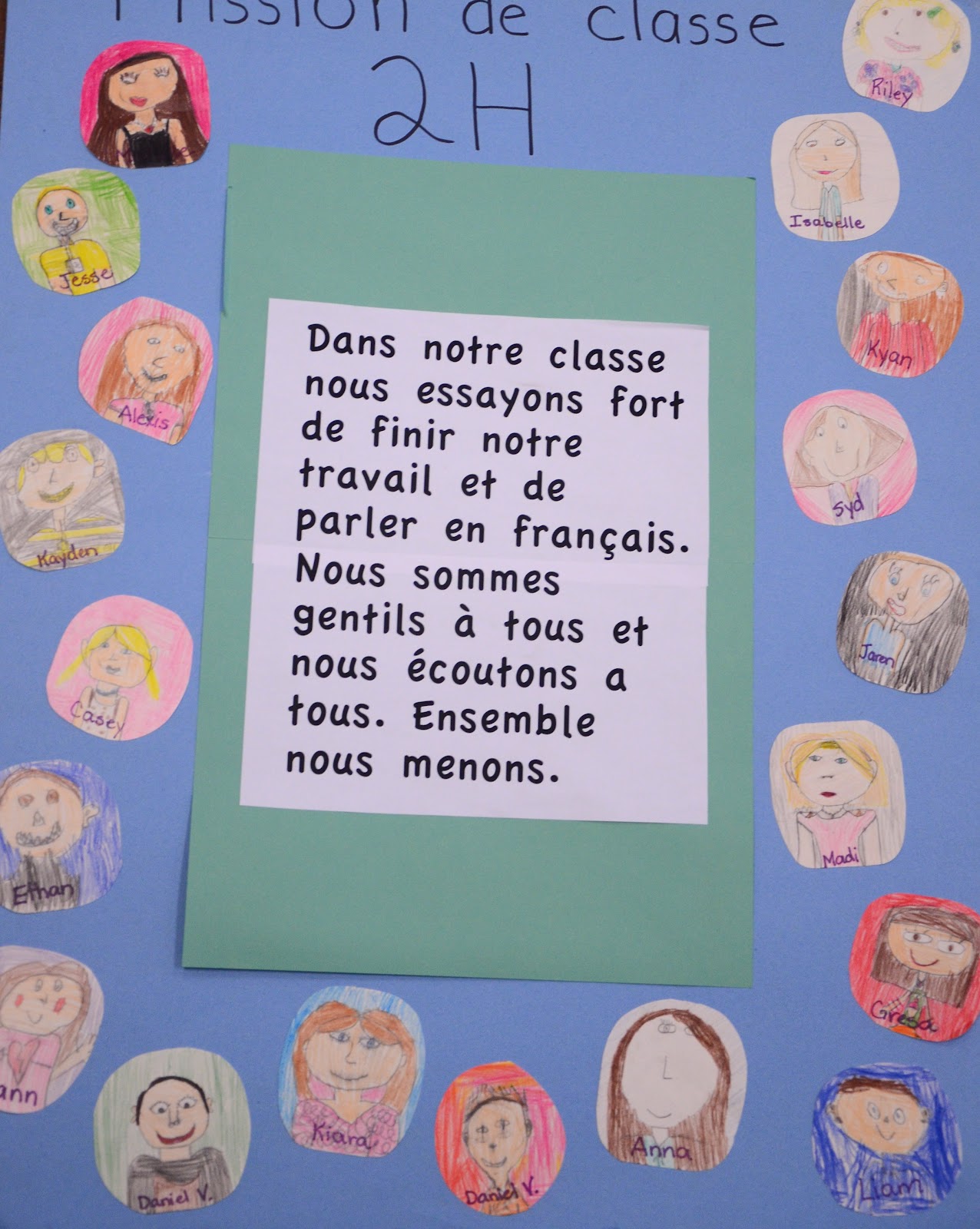

* correction: en travaillant ensemble (aucun 's')


* correction: nous travaillerons et nous nous amuserons


* correction: nous ferons notre possible pour . . .
la structure "faire notre possible de" n'existe pas en français, on dit "faire notre possible pour".


(meant for families but applicable to classrooms)
