Tuesday, September 25, 2012

la nuit, les formes, l'halloween

See geometry rubric here. Post of 3D objects can be found here.  Clear targets and learning outcomes are missing from this post, will update!

I usually refer to this unit or these materials under the heading "night creatures" and use them in October (some schools, communities may choose not to celebrate Halloween).  This unit coincides with  math topics around 2D shapes and vocabulary for grades K-2 French Immersion.

We make a lot of mini books in K and grade 1.  They don't encourage creativity BUT we are trying to fill our read-to-self boxes for Daily Five with some books we CAN read.  Students take them home to read.  They are successful early on in French Immersion with words they know.

Fall word strips of the unit


Fall visual dictionary of the unit for journal writing, Daily Five


Thanksgiving card, circles and triangles are great for beginning cutting skills in K


Here are links to 2D Word strips and visual dictionaries, 3D object word strips and visual dictionaires.

This is a shape and colour book we made in kindergarten to add to our book boxes.

Halloween Shapes Collaborative book identifying how many shapes.  Several pages, students chose 1 and we bind them together as a book to read during Read to Self (K).

Halloween shapes mini book - same halloween images with shapes are used as above, students add the number word (K)


Accordion book of shapes and Halloween items (print back to back 11x17, accordion fold, grade 1)


Le feu follet - Carving a pumpkin booklet, reviews the parts of a face, students complete the sentence.  Show this example, have students draw and build their own book.


Number booklet lift the flap.  Student arrange the numbers in their book out of order so that they know the number word and amount and aren't just reciting words.


Flaps for each page of booklet, students choose a number and draw that amount of whatever item they choose, write the sentence.


Students begin to become aware of the plural form of words, a great mini lesson topic for Daily Five Work on Writing.
1-30 book - Complete, cut apart, put in order.

This may seem like busy work but if students colour all of the pumpkins orange and count using the booklet they are practising counting by twos - something I assess for first term.


Math journal (coincides with story below - FYI adopting a spider is mentioned in the story).  Use punches, stickers, students make their own.  Subtraction or addition.


Des histoires qu'on aiment!


Sunday, September 23, 2012

I Pick - en français

Thanks to Jamie on twitter (you can find her at @fiteach) I dug up an acronym for "I Pick" in French.  Five simple words to remind students how to pick "just right" books to read during Daily 5 (or any time).  Thanks to Madame Richards who posted the acronym CRICC.

Here's my visual and labels to help students remember.  (More Daily Five posts on this blog can be found here.)

What do you use?  Do you have something better?  I'd love to hear about it!


Click on the image below for this one from the blog Dix Mois:


This English version is on the teacher wife's blog:


Thursday, August 30, 2012

Teaching Citizenship - beyond rules


Have a look at the Leadership on Location Posters École Edwards Elementary students and teachers developed and posted around their school.  If we are all leaders, what do leaders do on the playground?  How can I be a leader on the school bus?  Is there such thing as being a leader in the bathroom?

You can download and print the posters here to large format. I typically send the files to the Staples Copy and Print Centre online and select poster size 20"x30". They cost $20. a print, Staples has a $15. poster sale about once or twice a year. I have heard there is more reasonable printing rates elsewhere, suggestions have been Costco and Superstore. I did some trimming to fit them into $10. frames (from Ikea). The document has all 26 posters and is a large file - just a warning, it may take some time to download.

This slideshare shows some of the posters. Students decided what the bullet points should include.


Using the Covey 7 habits of happy kids as guiding principles, and keeping in mind the new mission and vision the school had developed, students gathered, sorted, edited, and revised specific behavour goals for various locations around the school.  Their writing was made into posters that are mounted throughout the school.

Students and visitors can easily see the leadership and citizenship goals of the school.  The posters don't change behaviour.  They don't replace sound teaching, regular review, and authentic modeling.  They simply remind anyone who walks the halls that leadership is not some grandiose and elite club reserved for prime ministers and principals.

Come to Edwards to find the leader in you. 
Leave Edwards a leader for life.


The photos used on the posters are creative commons licensed and are footnoted along the bottom.  Were we to do it again we would use students artwork instead.  I created the posters in Pages, the publishing program from the iWork suite for Apple.  It's a glorious and intuitive program that makes it easier than you might think to create your own "belles-feuilles"!

Madame Shannon Wiebe is a teacher, tweeter, parent, blogger, and leader in Airdrie, Alberta, Canada

This post was inspired by an interesting take on using (and not using) behaviour charts for students in the classroom written by Miss Night, a kindergarten teacher I follow on twitter.  I love being forced to rethink common practice because of an honest and practical blog post like this one http://missnightmutters.com/2012/08/too-high-a-price.html.  What is the goal?  Am I teaching a skill?  Is there a better way to teach the skill of behaviour and citizenship?

Wednesday, August 22, 2012

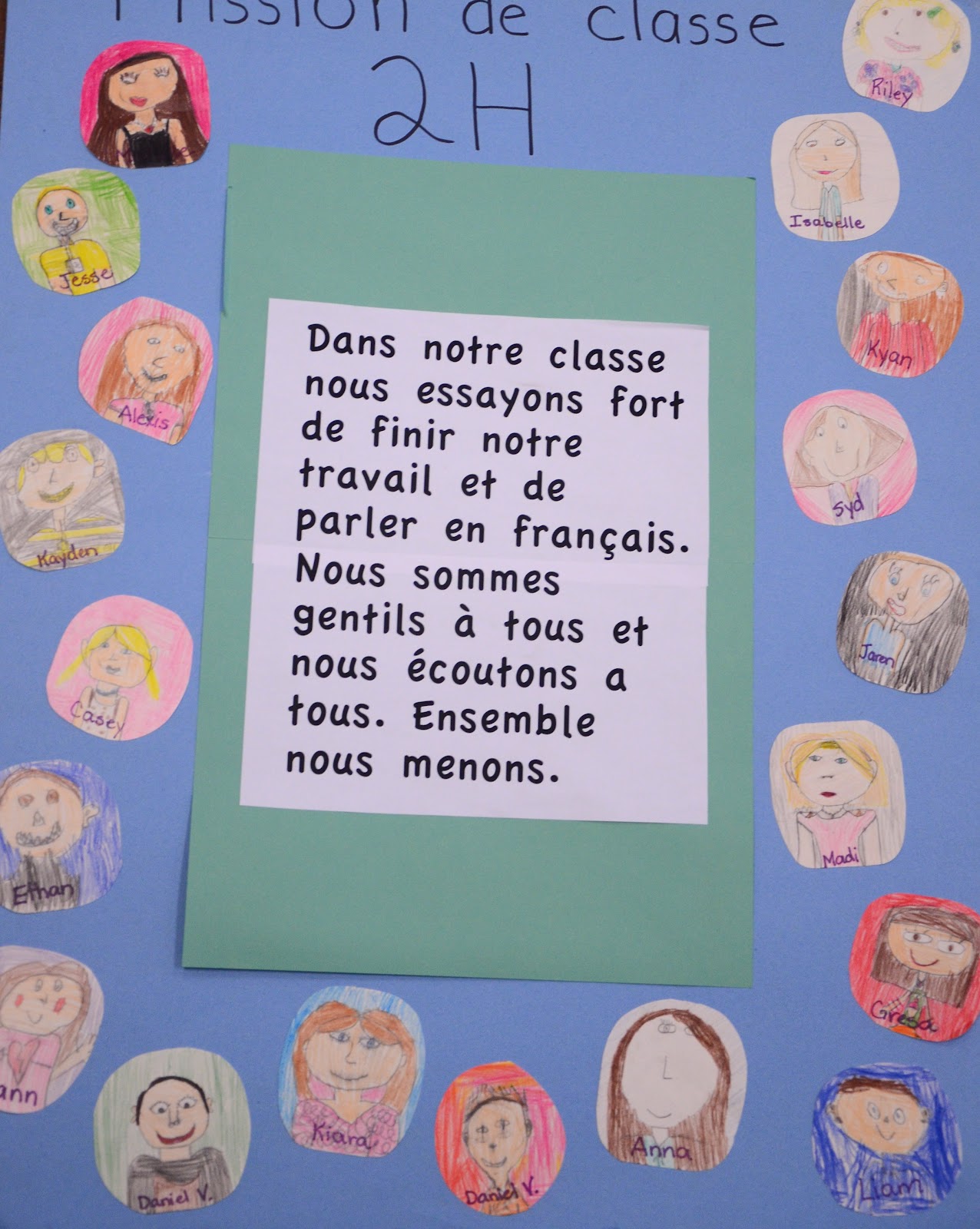
Classroom Mission Statements

Rather than the usual classroom rules why not develop a classroom mission statement with your students.  Often, these statements begin as a vision of how you would ideally like things to be.  Your mission then describes how you plan to reach your vision.

Questions to help guide you and your students (targeting k-2 students):

What is unique and special about you that you bring to this classroom?
Why do we come to school?
What do you want to learn in grade _____?
How do you feel about coming to school and our classroom?
How do you want to feel when you come into our classroom?
If someone (parent, administrator) were to describe our class, what would you want them to say about us?
What will you tell your parents or your siblings about this class?
Do we only come to school to learn?
Describe the best day ever at school.  What could we do to make every day that awesome?

In the end keep it simple, acronyms or rhyming phrases are easy to remember for young students.  Have students write the mission in their agenda or print it off on a magnet for parents to learn at home.  Refer to the class mission often throughout the year.  Use it to guide decisions and solve problems and conflicts.

In one school the mission statements must be created with students within the first week of school.  They are posted outside of each classroom, often with students signatures or artwork as a ‘contract’.  

Try creating your own professional mission statement.  It’s amazing how impacting it can be to whittle down your beliefs about children and teaching to a few simple basic statements about what you know for sure.

I believe that every child can learn.  I believe that every teacher can inspire.  I believe that everyone can lead.

Learn a habit.  Inspire a child.  Become a leader.

*  Une grande merci à Laura, une enseignante en France, pour avoir noter quelques erreurs de français parmi les affiches!


* correction: en travaillant ensemble (aucun 's')


* correction: nous travaillerons et nous nous amuserons


* correction:  nous ferons notre possible pour . . . 
la structure "faire notre possible de" n'existe pas en français, on dit "faire notre possible pour".


Links to help you get started:

(meant for families but applicable to classrooms)