Thursday, August 30, 2012

Teaching Citizenship - beyond rules


Have a look at the Leadership on Location Posters École Edwards Elementary students and teachers developed and posted around their school.  If we are all leaders, what do leaders do on the playground?  How can I be a leader on the school bus?  Is there such thing as being a leader in the bathroom?

You can download and print the posters here to large format. I typically send the files to the Staples Copy and Print Centre online and select poster size 20"x30". They cost $20. a print, Staples has a $15. poster sale about once or twice a year. I have heard there is more reasonable printing rates elsewhere, suggestions have been Costco and Superstore. I did some trimming to fit them into $10. frames (from Ikea). The document has all 26 posters and is a large file - just a warning, it may take some time to download.

This slideshare shows some of the posters. Students decided what the bullet points should include.


Using the Covey 7 habits of happy kids as guiding principles, and keeping in mind the new mission and vision the school had developed, students gathered, sorted, edited, and revised specific behavour goals for various locations around the school.  Their writing was made into posters that are mounted throughout the school.

Students and visitors can easily see the leadership and citizenship goals of the school.  The posters don't change behaviour.  They don't replace sound teaching, regular review, and authentic modeling.  They simply remind anyone who walks the halls that leadership is not some grandiose and elite club reserved for prime ministers and principals.

Come to Edwards to find the leader in you. 
Leave Edwards a leader for life.


The photos used on the posters are creative commons licensed and are footnoted along the bottom.  Were we to do it again we would use students artwork instead.  I created the posters in Pages, the publishing program from the iWork suite for Apple.  It's a glorious and intuitive program that makes it easier than you might think to create your own "belles-feuilles"!

Madame Shannon Wiebe is a teacher, tweeter, parent, blogger, and leader in Airdrie, Alberta, Canada

This post was inspired by an interesting take on using (and not using) behaviour charts for students in the classroom written by Miss Night, a kindergarten teacher I follow on twitter.  I love being forced to rethink common practice because of an honest and practical blog post like this one http://missnightmutters.com/2012/08/too-high-a-price.html.  What is the goal?  Am I teaching a skill?  Is there a better way to teach the skill of behaviour and citizenship?

Wednesday, August 22, 2012

Classroom Mission Statements

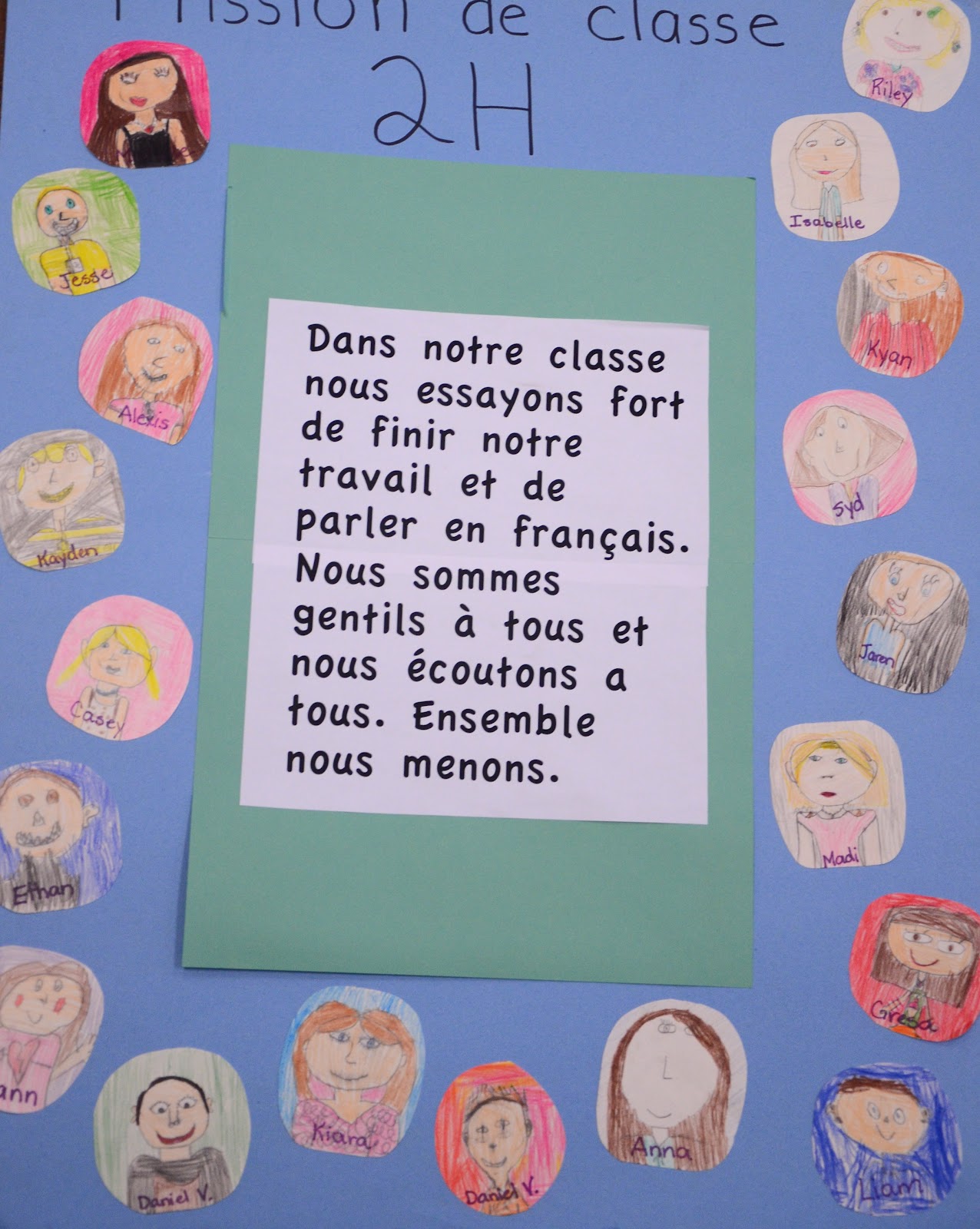
Rather than the usual classroom rules why not develop a classroom mission statement with your students.  Often, these statements begin as a vision of how you would ideally like things to be.  Your mission then describes how you plan to reach your vision.

Questions to help guide you and your students (targeting k-2 students):

What is unique and special about you that you bring to this classroom?
Why do we come to school?
What do you want to learn in grade _____?
How do you feel about coming to school and our classroom?
How do you want to feel when you come into our classroom?
If someone (parent, administrator) were to describe our class, what would you want them to say about us?
What will you tell your parents or your siblings about this class?
Do we only come to school to learn?
Describe the best day ever at school.  What could we do to make every day that awesome?

In the end keep it simple, acronyms or rhyming phrases are easy to remember for young students.  Have students write the mission in their agenda or print it off on a magnet for parents to learn at home.  Refer to the class mission often throughout the year.  Use it to guide decisions and solve problems and conflicts.

In one school the mission statements must be created with students within the first week of school.  They are posted outside of each classroom, often with students signatures or artwork as a ‘contract’.  

Try creating your own professional mission statement.  It’s amazing how impacting it can be to whittle down your beliefs about children and teaching to a few simple basic statements about what you know for sure.

I believe that every child can learn.  I believe that every teacher can inspire.  I believe that everyone can lead.

Learn a habit.  Inspire a child.  Become a leader.

*  Une grande merci à Laura, une enseignante en France, pour avoir noter quelques erreurs de français parmi les affiches!


* correction: en travaillant ensemble (aucun 's')


* correction: nous travaillerons et nous nous amuserons


* correction:  nous ferons notre possible pour . . . 
la structure "faire notre possible de" n'existe pas en français, on dit "faire notre possible pour".


Links to help you get started:

(meant for families but applicable to classrooms)

Saturday, July 7, 2012

letter names and sounds - self-tracking


In French immersion kindergarten classes students track their knowledge of letter NAMES, then letter SOUNDS (grade 1) and SOUND BLENDS (grade 1).  


Students select a car (printables included), and we race to get to the green light on the poster in class!


There is so much at school that easily engages girls that I look for the boy factor in everything I do to engage them too.


A folder with the same graphic is sent home explaining the challenge to parents & the difference/importance of letter sounds vs. simply letter names (although we start with letter names to build success and start from what they know). 


The back of the folder gives parents the phonetic spelling of letter sounds in French.

To encourage parents new to our school (kindergarten parents especially) to get in the habit of visiting my teacher page I sent students home with black and white photocopied car choices.  If their parents visited my teacher page they could download additional "cool car choices". 
Letter sounds and names that are the same in French and English are highlighted for parents as a starting point.


Letters are moved from one side of the folder to the other as they are mastered at home.


The file includes lower case and upper case letters.  We learn to print upper case first - what do you think?  Should they be taught to recognize lower case first?


Resolving the confusion of 'i' and 'e' and 'j' and 'g' for young French second language learners.

Thursday, July 5, 2012

me voici - activité en septembre

In the first week of school brown bags are sent home with each student.  Students fill them with items representing each criteria.  Once at school we share some of our contents all together.


It's difficult to have time and patience for young one in Sept. to share everything.  We do some of the sharing all together.


 As always I post my example to my teacher page to give parents an idea of the expectation and to let them know more about myself.  I present my bag along with the students (I show them a favourite French and English book as the keeners will panic if I show a French book and they only have an English one!).

In a circle I ask students take out the item that represents a favourite.  Do you see someone with something similar to yours?  Is there something no one else has?

Hold up what you would like to do better?  Use this opportunity to talk about goals for the year.
Photograph the contents, post at a centre with names, students try to match the students in the class with the photos of the items and practice writing friends names (K).  In grade 1 students can use the photos as writing prompts as they draw themselves and other students and what they like or don't like.

Voici Madame Wiebe.  Elle aime courir.  Elle n'aime pas avoir des bébites dans son lit!  Dans sa famille on joue le basketball.


I love the Scaredy Squirrel books for the beginning of the year and we read this story together on brown bag day.  Thanks to my awesome teaching partner Madame Hamilton who introduced me to this way of getting to know students.

Sunday, July 1, 2012

Happy Canada Day Sicamous!


All my love to the residents of Sicamous today.  These are my photos from Canada Day 2011 - hope to celebrate in your beautiful town again soon.

- Shannon Wiebe


Tuesday, June 26, 2012

Social Studies - Mon monde et moi, unit 1

Clear Targets for our first unit Belonging in My World, loosely based on suggestions in the Many Voices District resources.

themes:  belonging to different groups, the value of being part of a group, rights and responsibilities

These resources are a catalyst for discussing rights and responsibilities at the beginning of the year or in November in conjunction with International Children's Day.  


Cards of groups students may belong to, cards are used to sort, identify with, use in drama games and writing.  Also sorted as which groups do you belong to automatically and which to you join as a choice?


I add cards each year for new students interests.  YOU MAY HAVE TO ADD THE ACCENTS TO ALL OF THESE CARDS.  Cut into 4, laminate.


Cards of careers.  Used in kindergarten for a community helpers unit (this is just a sample, men and women, traditional and non-traditional).


Community helpers visual dictionary.  Great for independent writing.


Posters of the rights of the child (they are each linked to the seven habits of happy kids as we are a  Leader in Me school).  Have students generate their own posters and identify a responsibility that would accompany each right.

les pancartes des droits de l'enfant (printable)


 Cut and paste to review rights and responsibilities.  Following the activity students use their sheet during the week to track when they exercise each right and in turn exercise each corresponding responsibility.  Students later illustrated the right they are most thankful they can enjoy as a Canadian citizen, I bind their responses into a collaborative book to add to the classroom library. (you may have to add the accents, sorry!)

les droits et les responsabilités (printable to 11x14)

We make collaborative books every month and put them into clear sleeves to add to the classroom library.  At the end of the year each child's pages are bound into a book that they wrote and can read.  Here are the pages for this month.  

Student brought in symbols from groups they belong too (uniforms, medals, guide books, artifacts).  I photographed them and added the photographs to this page.


About me and my groups poster.  Originally used for K but is appropriate for Grade 1 also. Great for students to present to the class and to parents on student showcase night.


Overview of Universal Children's Day celebrated on November 20th.


Precede watching the video with; What is a right?  What do you think you have a 'right' to (what do parents and teachers HAVE to let you do?).  Do you think it's the law for you to have the right to things or is just a nice idea?


Thursday, June 21, 2012

drama games, bird mini unit continued

You read the story, made the birds, still a day or two to go and it's gotta be fun!

Distribute the strips below to each student (there are only about 20).  Re-read the story.  As students hear where the cat found birds have students put their corresponding strip on the whiteboard/in a pile/in a bin.  Use the word strips for the following drama activity.

2 Options, for both games students use the word strips of locations from the story for their pantomime.  Be selective with the locations, some fit the drama activity well some do not (ie, dans un cage):

Impromptu Solo Pantomime:

With only a few minutes to plan, an actor (student) pantomimes (no talking) a simple activity and the audience guesses what it is.  The audience waits until the performance is completed before guessing.  The audience then recounts details of the performance.  The actor can also simply announce the activity in advance, in which case the audience does not guess the scene, but evaluates how well the actor communicated.  For example if the student draws, at the beach, they pantomime something they would do at the beach.

Impromptu Group Pantomime:

Four actors (students) pantomime the general activity of being, for example, "at a farm" by pantomiming specific activities, milking a cow, riding a horse, herding cattle, checking crops.  The audience will usually first recognize the general activity and then point out the different specific activities.

Suggestions:

Quickly assign students groups and hand them a word strip of one of the locations birds were seen in the story (keep it secret and hidden from the other groups).  Make sure all the actors know they are to pantomime an activity, and not to speak.

As the participants plan their performances, circulate around the room, making sure that each group member plans to do a different specific activity.  be prepared to prod:  "what are some of the things you do when you are at the beach?"  Keep the planning time short - five minutes.

Locations from the story "Ah ces oiseaux", "Have you seen birds" by Barbara Reid.


Students have heard the story, made clay birds, participated in the story, dramatized the settings in the story.  Now, go and write and describe where your little clay bird is and who spotted him (in the story it's a cat, will it be a predator?  An observer?).

Play Crows and Cranes (Les hutardes et les mouettes, de notre histoire!).  If you love how easy-to-follow these PE game instructions are check out this site, my new favourite at The Physical Educator.


One more, only if you're hard core, go to Project Wild and play migration headache (À tire-d'aile).  It isn't as complicated as it looks and it really gives students an understanding of the threats to migratory birds.

Here are the habitat scenario cards, not in French yet . . .