Showing posts with label math. Show all posts

Friday, March 16, 2012

les journaux de mathématique

All of the math journal printables here


I have posted these individually throughout my blog.  Every month is included in this post with some changes to better suit the math strand studied at the time.  Some in the photos are for Kindergarten, some for grade 1.  The printable gives further explanation.

Math journals can be used to end a unit.  When they are related to the season or topic of study students enjoy a 'craft' with another curriculum based purpose.  Students begin by making a cover once they have learned about ABA, ABBA, and ABC patterns in September.  Once the journal is complete and in a portfolio or bound students have a book to read and take home at the end of the year.

This idea originated on a site called Kinder by Kim.


Cover of the Journals (patterning in September).  Coloured strips of construction paper were pre-cut, students cut them into squares. 


Sunday, March 11, 2012

les 70 et les 90

70 and 90 posters (only a few numbers as examples)

Madame Zolondek taught me this trick and it's magical for those few students who just can't seem to get reading the 70 and 90 numerals in French.  Here are some posters to demonstrate the trick for students.
Here are some handy school or home practice card kits.  They are printed on different colours of card stock with suggestions on how to use them in English with the idea that parents will also understand the task.  They are gathered onto a ring for practice.  The plastic containers are butter boxes from the dollar store.
Use these cards for Word Work to practice reading and writing numeral words.  Making the kits are time consuming so have them returned when students are through with them.  Or, send home the printed sheets and have students make up their own kit.

Sunday, February 5, 2012

un pour l'escargot, dix pour le crabe


This math infused read-aloud coincides with our science unit about the needs and adaptations of animals.  Tubs of small plastic animals make creating our own stories a snap.  Students were encouraged to find many animal combinations of feet.  At your table can you and your partner make 10 feet?  7?  20?  How many different combinations can you find for 12 feet?

Thursday, February 2, 2012

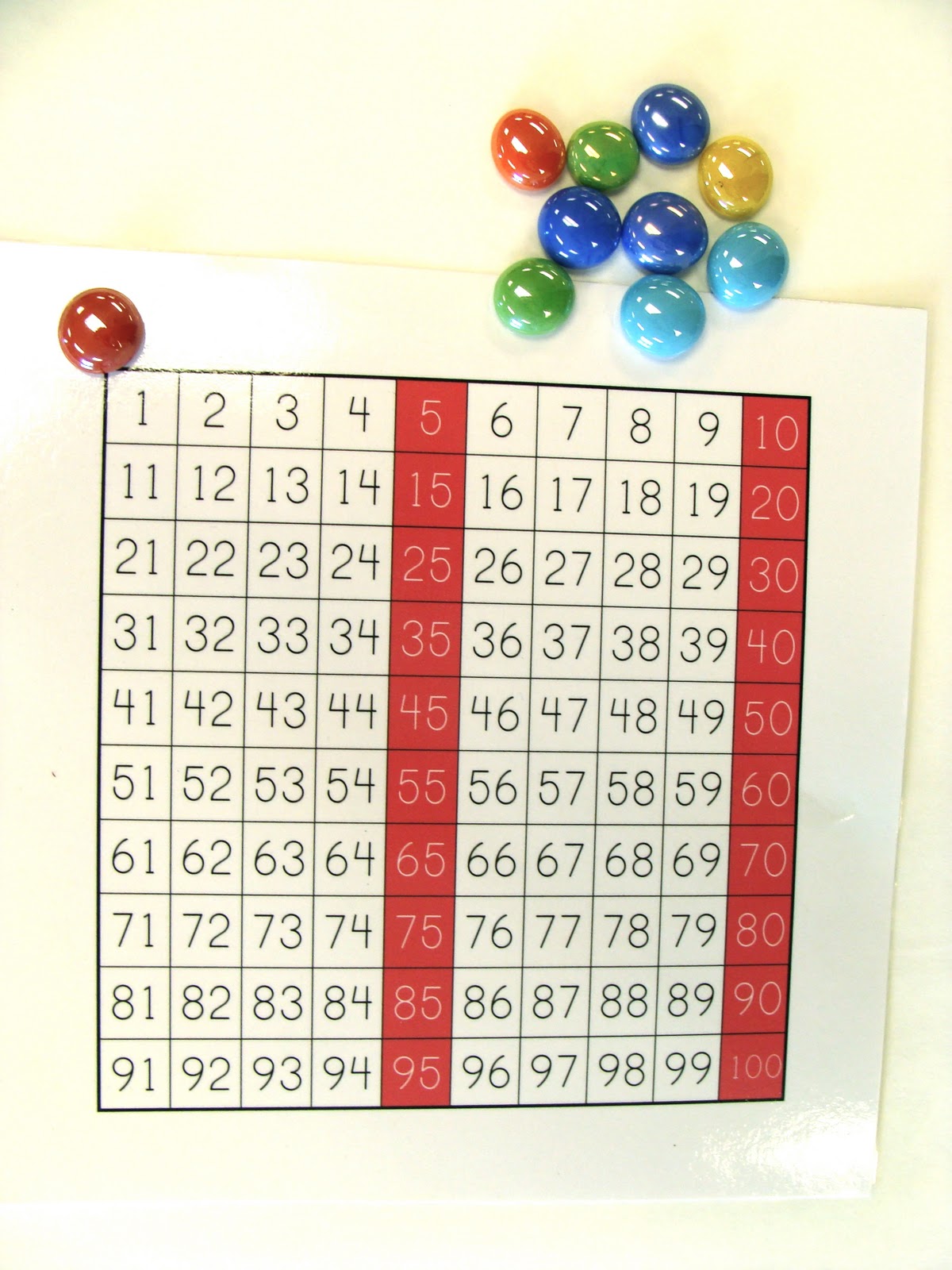
tableau de 100


This file is about 15 pages long because of course, you just have to have lots of colours to choose from. My deal with colour choice for students is, once materials are distributed, if you can make a deal or trade with someons (find a win-win), go nuts.  There is always some frantic deal making, I often set a quick time limit.  This takes the hassle out of my hands and injects some problem solving and haggling skills into grade one (or kindergarten, ha!). 

I print a class set on card stock and laminate them.  Each student has a chart and a flat glass bead.
As we count during calendar time students slide their glass bead along.
Use later for skip counting and counting on.  Students can call out a number and they all slide their bead to that number.  I can do a quick assessment with a checklist when students are sliding their beads along, do they seem to be counting by 5 accurately?  Do they need more practice?  Do I need to meet with them one-on-one to confirm where they're at?  The back can be used as a response board with a dry erase marker or whole group problem solving during calendar time.

Wednesday, February 1, 2012

les nombres en mots


It's important for students to gain number sense and subitize numbers in many different ways.  This visual is a staple in my room.  Some brilliant teacher insisted I add zero - of course, don't forget zero!


cent c'est beaucoup trop


Following the reading of a book I made students created their own book pages about when 1-00 is too much, and when 100 is not enough. The book topic was sent home over the weekend so that students could discuss and come up with ideas at home.  Download the document here --> Cent - livre et page pour les élèves. I wish I would have photographed my students' work for this post!

This book compares when 100 might not be enough and when 100 is way too much.  After much brainstorming students create their own page for a collaborative book by completing the sentence,
"100 ____ is not enough (ne sont pas beaucoup), but 100  ____ is way too much (sont beaucoup trop).

It was helpful to start by listing all kinds of little things that when gathered together still do not add up to very much at all.

A few pages from the book I made. It is in the downloaded documents above.


Sunday, January 29, 2012

les objets - 3D


I use the Geometry Rubric for grade 1 from Math Makes Sense (this is a photo only - you will need the resource for the PDF).

I print off one for each student and keep notes right on the rubric (print to 8.5x14 for more room).

This is a great way to communicate to both parents and students which skills they have mastered and which they are still learning.  I send these home for parents to sign during the unit and at the end of the unit.  They are returned and kept in the students' data notebook  to facilitate report card writing.


Here is the 3D visual dictionary of vocabulary students used for this unit.


These are the 3D word strips that are in the file above.  It includes all of the 3D shapes, this is just  a thumbnail.  I like to have students describe the difference between "un coin" et "un sommet" for example.  These kinds of discussions get at a deeper understanding of the properties of shapes.

How many faces does a cone have?  Are faces always flat, or can they be curved?  Are edges always straight?


Here is the 2D visual dictionary and word strips that I print back to back with the 3D visual dictionary above.  I made this when I was teaching kindergarten and really should have added the other polygones.  They are in the word strip document.  Add that to the list . . .


2D word strips are in the file above.  Great for pocket charts, sorting, independent writing, making sentences and for Daily Five word work.


These are pages to a take-home book we made.  Students can write their own clues for each shape, use the ones provided or print them off as fill in the blank.


Students sorted small toys describing whether they could roll or stack.  We are built and described 3D structures (big lego, lots of plastic cups, super fort, wooden blocks, toothpick and marshmallows).

Students discussed, how many edges does your structure have, how many vertices, how many faces? 

Using your building materials can you build a cube?
 A cylinder?  A sphere?
Easy to understand French preschool video about "les formes" to watch during snack.